

Risk Management · 2025
In this section2 topics
Risk Management Policy & Plan
Policy & Plan Description
Amidst volatile and complex economic conditions, the Board of Directors places great importance on proactive risk management, covering both internal and external factors, as well as social and environmental dimensions, to transform challenges into business opportunities and build confidence among stakeholders, thereby driving the organization towards sustainable growth. The risk management plan has been established as follows:
Monitoring: Analyze comprehensive risk factors amidst global economic uncertainties.
Responsibility: Mindful of social and environmental impacts (ESG).
Creating Opportunities: Transform risks into competitive advantages.
Create sustainability: Generate added value and reliable returns for all stakeholders.
Governance Structure
The Board of Directors has appointed a Risk Management Committee, comprising independent directors and company directors, with an independent director serving as the Chairman of the Risk Management Committee. Its duty is to oversee compliance with the risk management framework and regularly report on risk management in accordance with the governance and risk management structure under various circumstances as follows:
Transparent Governance: A Risk Management Committee has been appointed, chaired by an independent director, to regularly oversee and report on risk management in accordance with international standards.
Strategic Risk Management: By considering policies and assessing the risks of complex key investment projects to prevent impacts on the company's financial stability.
Organization-wide Integration: By linking the risk management system with operational processes (Value Chain) through key risk indicators (for close monitoring and surveillance.
Culture and Sustainability: A risk management culture is instilled at all levels to support stable business expansion and generate appropriate returns for shareholders.
Operational Guidelines and International Standards
The company integrates risk management according to the COSO-ERM framework, with the Risk Management Working Group (appointed on June 1, 2023) serving as the primary mechanism for systematically driving management measures, as follows:
Covering Risk Dimensions : Assess and manage 4 key areas of risk, namely
Strategic and Operational Aspects (Strategic & Operational Risk)
Financial and Regulatory Aspects (Financial & Compliance Risk)
Sustainability Aspects ( ESG Risk)
Emerging Risks ( Emerging Risk)
Managed within limits D: Control risk levels within acceptable limits ( Risk Appetite & Tolerance) to maintain organizational stability.
Enhancing Resilience (Resilience): Focus on proactive adaptation to effectively respond to external impacts (Global Impact) and global trends (Global Trend).
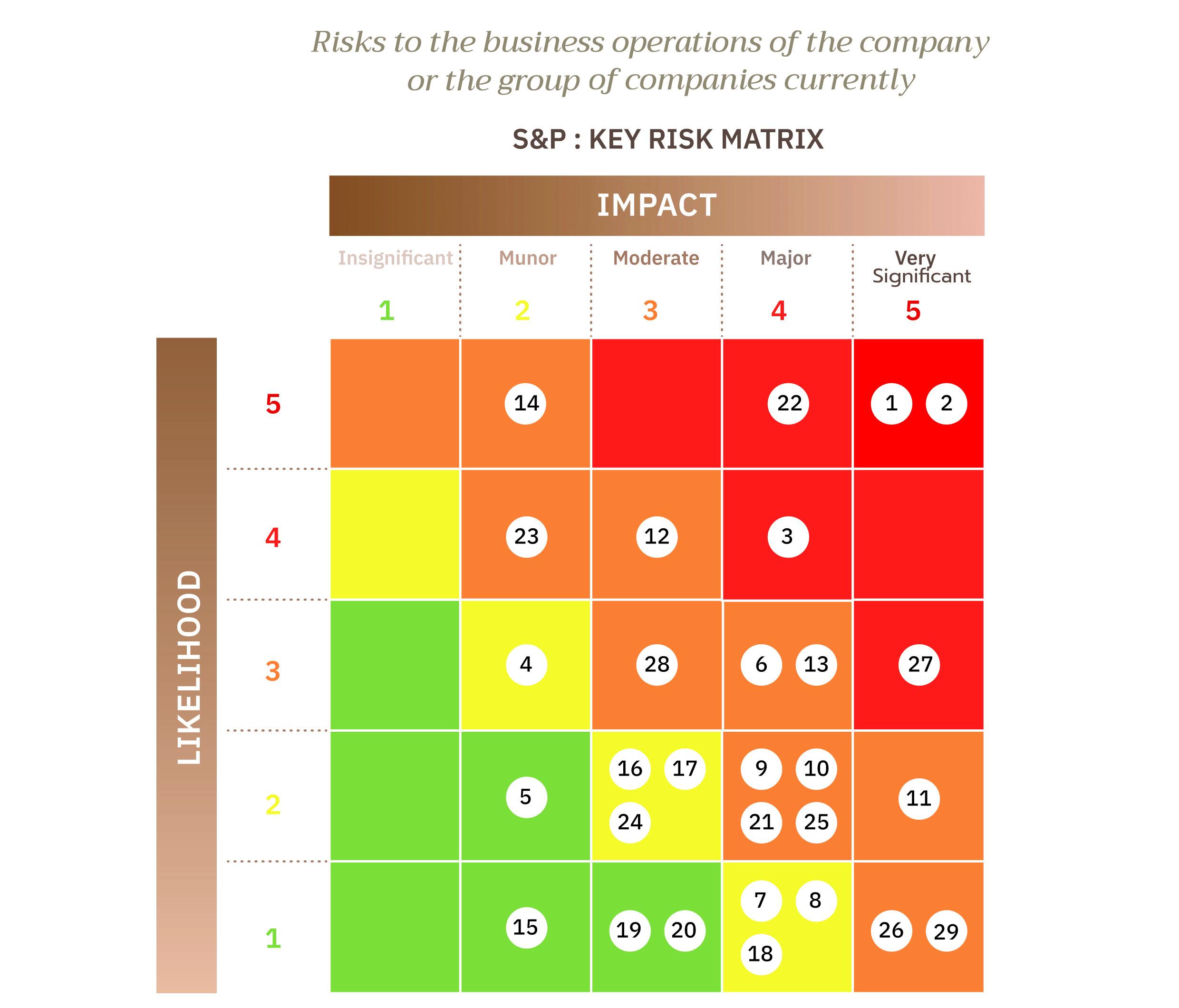
Risks to the Company's Business Operations
Risk Register
| Risk Name | Risk Characteristics | Consequences | Management Measures | Related Risk Factors |
|---|---|---|---|---|
| Risks of Changing Consumer Behaviors | A lack of consumer behavior analysis, including understanding why and how consumers make purchasing decisions as well as the ability to adapt strategies to better meet the needs and preferences of the target consumers. | Customers may feel dissatisfied or choose not to purchase S&P’s products or services, potentially leading to loss of customers. S&P may face risks from competitors who are more adept at adapting to market changes. | Mitigation Plan 1. Develop business strategies and plans based on customer demand and preference analysis using company statistical data, such as sales by product category, sales per transaction, and daily sales. 2. Monitor and report operational performance according to plans and presenting results in weekly marketing department meetings and monthly management meetings. 3. Collect and analyze competitor data to create annual reports tracking businesses in the same or similar industries, including trends affecting products, pricing, and distribution channels both domestically and internationally (Competitor Benchmarking). Solution Plan 1. Conduct research and development for new products based on statistical data and contemporary consumer behavior studies. 2. Utilize innovative technologies, such as Artificial Intelligence, to analyze consumer behavior and preferences along with tracking emerging trends that influence consumer lifestyles. | 729 · Description: Behavior or needs of customers / consumers · Info category: STRATEGIC_RISK |
| Risks of technological or innovative interventions that rapidly and drastically change consumer behavior | Amidst the impact of technological and innovation disruptions on consumer behavior, in an era where digital technology is transforming every aspect of business operations, strategic risk management has become essential for organizations that need to adapt to the increasing consumer preference for purchasing products via online platforms. | 1. Intensified Competition: The adoption of technology has lowered entry barriers, making it easier for new competitors to enter the market. 2. Changing Customer Expectations: Consumers now demand faster and more convenient experiences. 3. Business Model Disruptions: Traditional business models may become obsolete if organizations fail to adapt to rapid technological changes. | Mitigation Plan 1. Analyze and Understand New Technologies: Assess all dimensions of emerging technologies, including their positive and negative impacts on S&P’s core business and the overall food industry. This enables swift formulation of plans to take advantage of new opportunities and manage risk from technological charges in a timely manner. Conducting relevant industry visits can aid this process. 2. Competitor benchmarking: Study similar or related businesses and the technologies they adopt. Additionally, analyze key trends in countries with comparable or more advanced socio-economic cultural and per capital income conditions than Thailand. 3. Examine how technological advancements affect the entire food industry. Solution Plan 1. Carefully execute predefined strategies while continuously tracking technological changes to make necessary adjustments. 2. Innovate and adapt suitable new strategies to align with evolving technology and shifting consumer behavior. 3. Invest in suitable cost-effective technology: In order to enhance production processes, improve efficiency, and develop innovations that align with changing consumers behavior. | 732 · Description: Changes in technologies · Info category: STRATEGIC_RISK |
| Business Competition Risks | Business competition risks are, for example, the decline in brand popularity: and the loss of market share. | 1. Decline in brand popularity 2. The consequence is that profitability or expected returns on business investments may not meet projections. 3. Loss of market share. | Mitigation Plan 1. Update product presentation to present a more attractive and contemporary image, such as by packaging redesign or changing food presentation in the restaurant outlets. 2. Closely track and analyze market competition by defining the relevant market scope, including competitors in the same type of business (direct) or similar types of business (indirect). The Company also assesses shifts in market trends caused by new entrants into the market, new products, and new sales channels, especially factors that negatively affect S&P’s competitive ability and potential business expansion opportunities. 3. Develop new products and continuously offer promotions and organize marketing activities that are engaging and suited to each customer segment. In addition, accelerate the creation of repeat customers through S&P’s membership system to promote lasting customer satisfaction and long-term brand loyalty. Solution Plan 1. Increase brand recognition and credibility through various channels, both online and offline, as well as the customer membership system. Build brand confidence through appropriate advertising and public relations efforts. 2. Identify opportunities for business growth through investments, partnerships, or acquisitions of new brands that align with consumer demand or target markets that differ from S&P’s existing customer base. 3. Utilize new technologies and innovations to drive product development and enhance product quality and services to meet customer needs. 4. Improve production efficiency. Reduce costs using Lean Process principles while maintaining product and service quality, enabling S&P to remain competitive in terms of pricing and suitable promotional offerings. | 1714 · Description: Competition risk · Info category: STRATEGIC_RISK |
| Risks in Succession Planning for Key Positions in the Organization | Effective succession planning is essential to prepare for future leadership transitions, support business growth, and ensure seamless management continuity. | 1. Lack of clear direction and planning. 2. Certain tasks may be interrupted or delayed due to a lack of continuity. 3. Loss of both clients and employees 4. High costs associated with replacing and training new personnel. | Mitigation Plan 1. Define succession planning policies for the levels of Chief Executive Officer (CEO), high-level executives (C-level), executives and Vice Presidents, in order to clearly manage the retirement of executives and positions that become vacant for other reasons, taking into consider the qualifications and the expected number of successors. 2. Engage the Nomination and Compensation Committee to ensure the committee participates in reviewing succession policies and assessing the qualifications and suitability of candidates for CEO, C-Level, and Vice President positions. 3. Evaluate and compile a list of potential internal candidates who meet the criteria for key leadership roles. 4. Establish a policy for the rotation of responsibilities for senior executives with potential as successors for significant positions, and to enhance their leadership potential, preparing them for higher positions. Regular and fair performance evaluations should also be conducted. Solution Plan 1.Establish clear succession timelines and transition steps under the supervision of more senior supervisors. 2. Continuously evaluate internal candidates’ performance. If they do not meet expectations, provide targeted development programs such as external training. 3. Recruit external candidates with the qualifications and suitability to be successors for key positions under S&P’s succession planning framework. | 738 · Description: Reliance on employees in key positions · Info category: OPERATIONAL_RISK |
| Risks Related to S&P’s Reputation and Brand Imitation | Risks related to company reputation and trademark imitation causing consumers to be misled such as similarities in brand logos or trademarks. | 1. Loss of revenue to counterfeit products 2. Decline in consumer confidence 3. Legal and intellectual property disputes | Mitigation Plan 1. Establish a clear policy concerning the organization's image to ensure that employees and executives consistently communicate S&P’s commitment of “Quality, Value, Virtue” to customers, business partners, and the public. 2. Organize events and disseminate information that positively impact S&P’s image while contributing to society and the environment. 3. Appoint a Crisis Management Team (CMT) to handle incidents that may affect S&P’s reputation, led by a C-level executive as the Chairperson of the Crisis Management Team. 4. Implement a robust crisis communication framework to manage urgent and unforeseen incidents efficiently. 5. Designate personnel to engage and negotiate with customers in alignment with S&P’s policies. Solution Plan 1. Identify key personnel, contingency plans, and standard operating procedures for reputation-related crises, particularly for high-risk or high-impact situations. Ensure that a C-suite executive is the primary decision-maker. 2. Invite specialists and/or regulatory bodies to clarify issues and reassure customers and the public. 3. Establish a dedicated unit to negotiate or take legal action against violators. | 736 · Description: Damage to company image and reputation · Info category: STRATEGIC_RISK |
| Risks from Improper Conduct of Branch Employees | Inappropriate conduct of front-of-store personnel (Branch Operation Mismanagement) such as: 1. Fraud and lack of proper internal controls 2. Excessive waste management, leading to lost sales opportunities 3. Service quality that requires improvement | 1. Inadequate service operations negatively affect customer satisfaction, potentially leading to customers not returning for repeat transactions or choosing competitors instead. 2. Fraud and poor internal control scan result in financial losses for the Company. 3. Excessive waste management leads to lost sales opportunities, as customers may not return if they are unable to purchase the products they want. | Mitigation Plan 1. Establish clear and actionable work processes. 2. Ensure 100% of employees receive training. 3. Conduct regular inspections of QSC, Audit Me, and internal audits. 4. Supervisors must oversee and manage operations. 5. Implement a Customer Satisfaction Rate (CSR)system. 6. Utilize AI Fraud Detection for real-time monitoring with clear evidence. 7. Gather and analyze customer feedback to assess service satisfaction. Solution Plan 1. Deploy a SWAT team to immediately manage incidents, analyzing risk vulnerabilities to prevent a recurrence of incidents. When an incident occurs, a SWAT team must be deployed immediately to manage the situation. A thorough analysis of risk vulnerabilities that require improvement should be conducted to ensure that similar incidents do not happen again. 2. An Internal Audit team must conduct immediate investigations when incidents occur. 3. Raise employee awareness by informing them of incidents to emphasize the importance of ethical conduct. 4. Continuous customer service training with AI monitoring via CCTV to track improvements. | 742 · Description: Human error in business operations · Info category: OPERATIONAL_RISK |
| Risk of production disruption due to raw material shortages or substandard quality | Production may be disrupted due to insufficient raw materials in the market or reliance on a limited number of suppliers for key materials. This can lead to increased costs from using substitute materials, adjusting production processes, or facing shortages that hinder production capacity, ultimately resulting in lost sales opportunities. | 1. Shortages of raw materials and transportation problems can cause production disruptions and result in higher costs. 2. Outbreaks of diseases, natural disasters like droughts or floods, or climate change could disrupt production and lead to increased costs. 3. Errors caused by employee negligence in the production process can lead to disruptions in production and potential legal disputes. 4. Shortages of raw materials; logistical factors; suppliers’ production output impacted by geopolitical or conflict issues, leading to interruption of production, being unable to transport orders, or delays. | Mitigation Plan 1. Set a minimum order quantity in order to confirm pricing with suppliers. 2. The Procurement Department must maintain a list of multiple suppliers to ensure alternative sourcing if current suppliers fails to fulfill orders. 3. Identify alternative raw materials or substitute products. 4. Forecast raw material usage to effectively plan stock management for each material type. 5. Secure second or multiple suppliers and alternative materials & suppliers. 6. Develop a supplier audit checklist for key suppliers to monitor and inspect production quality, reducing risks from substandard production. 7. Organize an annual supplier meeting. Solution Plan 1. Source raw materials or products from alternative suppliers (Substitute Suppliers). 2. Develop substitute formulas for core products by using alternative raw ingredients in case of supply disruptions. 3. Be willing to pay a premium to existing suppliers to secure critical raw materials, ensuring supply priority over order producers. | 740 · Description: Shortage or fluctuation in pricing of raw materials or productive resources · Info category: OPERATIONAL_RISK |
| Risk of Unsafe Raw Materials (such as contaminated Ingredients) | Impact of unsafe and hazardous raw materials in food (food hazard) or Food Contamination, including the creation of pathogen breeding grounds, can lead to severe consequences, such as lawsuits and legal penalties. The production of food and bakery products in factories involves multiple complex processes, requiring strict responsibility for consumer safety. | 1. Consumers may lose trust in the Company’s products, which could negatively impact the brand and other product lines. 2. There is a risk of legal action from consumers if they suffer harm due to contaminated raw materials. | Mitigation Plan Impact from unsafe raw materials (such as contaminated ingredients) 1. Production and sales must be stopped immediately upon detecting contaminated raw materials. 2. Product specifications must be reviewed regularly to ensure compliance with certification standards. 3. Secure second/multiple suppliers and alternative materials to mitigate risks. 4. Implement a supplier audit checklist for key suppliers to monitor and verify production quality, reducing risks associated with substandard production. Solution Plan 1. Activate Business Continuity Plan (BCP) and measures based on the severity of the incident. 2. Recall affected products from sales points while ensuring clear communication between the Call Center and branch employees to address customer inquiries, especially if customers who purchased the product have already contacted the Company. 3. Trace the source of contamination to determine possible corrective actions. If necessary, evaluate and procure new and reliable suppliers. | 755 · Other name: Impact from unsafe raw materials (such as contaminated ingredients) · Description: Other · Info category: OPERATIONAL_RISK |
| Risk of Production Line Disruptions and Issues from Production Support Systems | Disruptions in the production line due to failures in utility support systems can severely impact manufacturing continuity. These failures may lead to lost sales opportunities and potential lawsuits from business partners if products cannot be delivered on time. | 1. Lost sales opportunities due to insufficient production capacity. 2. Emergency repairs may require additional overtime expenses 3. Urgent procurement of spare parts or substitute materials may incur excessive costs. 4. Delays in diagnosing and resolving issues may lead to operational inefficiencies. 5. Failure to deliver products on time could result in lost orders and diminished customer satisfaction. | Mitigation Plan 1. Evaluate risks related to production continuity and identify potential failure points. Periodic skills assessments are conducted to ensure production staff possess requisite expertise. 2. Establish maintenance protocols and stockpile essential spare parts to prevent production halts. The Company assesses risks related to disruptions in critical utility systems such as electricity, water supply, and wastewater treatment. 3. Develop contingency plans to minimize the impact of natural disasters that could disrupt production. 4. Provide training for employees on a continuous basis, to upgrade their knowledge and expertise. Solution Plan 1. Create a detailed Business Continuity Plan (BCP) and present it to Management for approval. 2. Activate the BCP based on incident severity. 3. Re-evaluate the situation and adjust response actions accordingly. 4. Provide continuous training to enhance employees’ skills and expertise. | 755 · Other name: • Others: Disruptions in the production line and failures in production support systems · Description: Other · Info category: OPERATIONAL_RISK |
| Risk of Labor Shortage in the Production Line | A shortage of production line workers can negatively impact personnel efficiency. Extended working hours may lead to employee fatigue, resulting in a high turnover rate, lower production capacity, and reduced product quality, ultimately leading to lost sales opportunities. | 1. Shortages of efficient workers ready to perform their tasks affects customer satisfaction and the overall service experience. 2. Insufficient workforce capabilities may hinder business expansion and development. | Mitigation Plan 1. Develop more automated processes while considering cost-benefit analysis. This includes evaluating suitable software, hardware, or automated operating systems to replace insufficient personnel. 2. Recruit temporary workers by identifying clear target groups, including migrant workers, to fill positions carrying out non-complex tasks. For more complex roles, provide training to temporary employees to enhance their capabilities. 3. If the production cost of certain items exceeds the allocated budget, consider outsourcing to suppliers. 4. Strengthen retention strategies by ensuring an effective and appropriate recruitment process. Solution Plan 1. If a labor shortage occurs, contact outsourcing agencies to secure replacement workers promptly. 2. Implement planned recruitment efforts, including offering higher wages if necessary to attract sufficient labor. 3. Explore the possibility of hiring inmates from correctional facilities while the Human Resources Department reviews potential legal and operational constraints. | 739 · Description: Shortage or reliance on skilled workers · Info category: OPERATIONAL_RISK |
| Risk of Cyberattacks | Cyberattacks, such as data loss and encryption or file locking, prevent users from opening files or accessing computers. The attackers then send ransom messages to users or organizations, demanding payment in exchange for decrypting and restoring access to the data. | 1. The Company may lose important data or be unable to access its systems, affecting business performance and customer trust. 2. The personal data of customers, suppliers, employees, or company information could be attacked and publicly disclosed, risking the Company’s reputation, legal disputes, and potential financial damages. 3. The Company may spend time and resources in resolving the issue, and business operations could be halted, negatively impacting productivity and services. | Mitigation Plan 1. Perform regular data backups by choosing methods that are separate from the main network to prevent ransomware and hacker attacks. Conduct data recovery tests annually to ensure that backed-up data can be restored completely. 2. Update operating systems and software, including patches (System Updates and Patches), and consistently monitor and track cybersecurity threats. The Company also installs system updates and antivirus software patches to close vulnerabilities that could be exploited by attackers. 3. Continuously monitor and secure the organization’s internet gateway. Any threat or incident that could affect the Company's network, it should be detected and reported quickly, followed by timely preventive and corrective actions. 4. Install firewalls and intrusion detection systems (IDS) to detect and block unauthorized attempts from external sources. 5. Define and manage access rights to software and data within the Company's systems. Set permissions and limit access to data for employees using various systems, enforce password policies, and require regular password changes. In addition, we also implement policies for regular reviews of access rights and system use. 6. Develop an incident response and recovery plan for ransomware and cyberattacks, with clear steps and coordination for all parties involved. The Company also conducts incident response drills to ensure everyone in the organization can follow the plan promptly when needed. 7. Establish a culture of awareness, regularly communicating cybersecurity threats to employees. Solution Plan 1. Install an Auto Data Backup System to back up critical data in the Company's core systems such as SAP, POS, and BOR. 2. Define and implement Windows Patch Updates and Antivirus Updates on Company servers and computers. 3. Set up and install Firewall Systems (IDS/IPS Features) to control and protect the IT network connections across all the Company’s locations, including the headquarters, factories, and all S&P branches. 4. Establish procedures for setting access permissions such as creating, deleting, or modifying user rights through an IT user request system. 5. Implement a password change policy on core the Company’s systems such as SAP, POS and BOR that makes it mandatory for employees to update their passwords every three months. 6. Review and update Incident Management Policies related to cybersecurity incidents to ensure comprehensive coverage for cyberattack scenarios. 7. Send emails to communicate and raise awareness, including alerts in various formats, to all employees. | 744 · Description: Information security and cyber-attack · Info category: OPERATIONAL_RISK |
| Risk of system and network disruptions preventing normal operations | Cyberattacks pose significant risks, such as data loss and ransomware attacks. In these cases, files or entire systems are encrypted or locked, preventing users from accessing them. Attackers then demand a ransom in exchange for decryption keys to restore access. | 1. Loss of access to critical data may cause important data to become inaccessible or permanently lost. 2. Cyberattacks can negatively impact business continuity and customer trust. 3. Organizations may be unable to operate, manufacture products, or provide services, leading to revenue loss. | Mitigation Plan 1. Install a Redundant Network Setup 2. Ensure efficient and uninterrupted Network Device Management. 3. Network Access Control 4. Perform Network Monitoring using 24/7 monitoring tools to analyze traffic, detect anomalies, and identify potential issues. 5. Disaster Recovery Plan Solution Plan 1. Use multiple internet service providers (ISPs) to ensure continuous connectivity. 2. Deploy network failover devices to maintain operations in case of hardware failures to ensure High Availability. Conduct regular network equipment checks and establish a preventive maintenance plan. 3. Restrict access based on employee roles and require VPN connections for remote access to reduce unauthorized data breaches. 4. Assign IT specialists to continuously monitor systems and servers 24 hours in order to respond to issues promptly. 5. Conduct regular business continuity plan (BCP) drills to simulate network failure scenarios, ensuring clear recovery procedures and response times. | 1720 · Description: System disruption risk · Info category: OPERATIONAL_RISK |
| Climate Change Risks | Increasingly severe climate change risks, such as storms or severe drought, or in the form of long-term risk such as a rise in average temperatures. | 1. Interruptions in the supply chain 2. Higher operating costs | Mitigation Plan 1. Implement environmentally friendly production processes and develop innovations that reduce the use of hazardous raw materials from upstream to downstream. 2. Enhance sustainability efforts throughout the entire supply chain. 3. Conduct research on renewable energy alternatives and promote environmental conservation. 4. Promote the use of recycled materials and waste reduction by raising awareness among employees and implementing regulations within the production process and sales operations (at branch levels). Solution Plan 1. Gather data and seek expert advice to formulate effective future strategies. 2. Implement measurable energy reduction initiatives that can be continuously improved for all processes or activities. 3. The Risk Management and Sustainability Committee must establish clear policies and goals while collaborating with senior management for effective execution. | 750 · Description: Climate change and disasters · Info category: OPERATIONAL_RISK |
| Risk of Increased Costs from Carbon Emissions Taxation on Industries or Businesses Releasing CO2 | Risk from changes in public sector policies and regulations concerning the environment, such as carbon taxes. | 1. Cost of production increases as a direct result of tax calculated from the volume of greenhouse gas emissions, causing a reduction in net profit 2. Product prices may be higher than competitors with cleaner production processes, which leads to a market disadvantage 3. Reserve funds may need to be set aside to pay taxes or purchase carbon credits to offset emissions that exceed quotas | Mitigation Plan 1. Create a carbon footprint account: systematically monitor and create a database of the Company’s greenhouse gas emissions in order to forecast the associated tax burden 2. Determine the Company’s internal carbon pricing by calculating the carbon tax pricing in investment budgets, so that the relevant business decisions take into consideration built-in environmental costs from the onset. 3. Inspect and improve production processes for increased efficiency, including utilizing raw materials and products with minimal gas emissions. 4. Closely monitor changes in carbon tax laws and CBAM regulations in order to adequately prepare before legislation comes into effect. 5. Train employees on the importance of reducing CO2 emissions and encourage their involvement in energy-saving practices and increasing work efficiency. Solution Plan 1. Invest in energy saving technology or machinery with low carbon emissions in order to reduce the associated tax base 2. Utilize alternative energy sources 3. Adopt financial strategies that emphasize the reduction of CO2 emission costs, such as using carbon credits to offset emissions | 1717 · Description: ESG risk · Info category: STRATEGIC_RISK |
| Risks of Human Rights, Occupational Health, Safety, and Labor from Stakeholders in the Supply Chain | Risks related to human rights, occupational health and safety, employee safety, and labor from stakeholders in the supply chain including risks from disputes with communities surrounding the factory location. | 1. Company image and reputation: any allegations of the Company supporting human rights violations could potentially lead to consumer boycotts or its removal from sustainability indices 2. Hazards to the life and property of employees and stakeholders in the supply chain may occur if there are violations of, or non-compliance with, the principles of human rights laws, for example illegal use of child labor, or other illegal utilization of labor. 3. May lead to lawsuits or the revocation of business operating licenses if violations of labor laws are found 4. Serious accidents that lead to cessation of the production line, or a shortage of labor due to unsuitable employment conditions, resulting in interruption of business operations. | Mitigation Plan 1. Announce and communicate the human rights policy to employees for their understanding and complianceas well as establishing clear monitoring procedures. 2. Implement measures to monitor, prevent, and control potential hazards. 3. Apply workplace safety measures and train employees accordingly. 4. Build positive relationships with the community through CSR programs and actively participate in community development and promoting the local economy. 5. Assess risks and the potential impact of human rights violations comprehensively and consistently in relation to all activities conducted by the Company and its trading partners. Solution Plan 1. Prepare personnel and equipment to ensure immediate action can be taken during emergencies of various forms while performing duties. 2. Set up a system for employees to file complaints regarding both human rights issues and safety in the workplace. | 749 · Description: Safety, occupational health, and working environment · Info category: OPERATIONAL_RISK |
| Risk of Internal Control Failures within the Organization | Risk in work systems with limitations or gaps including inadequate internal control systems | 1. Financial losses for the organization could impact the Company’s business operations. 2. Additional costs may be required for auditing and corrective actions. 3. Negative impact on the credibility of business partners and the trustworthiness of employees. 4. Loss of key employees who are important resources. | Mitigation Plan 1. Establish a diverse board structure with a transparent and independent decision-making process. 2. Implement regular internal audits, ensure a structured internal audit process, and enforce clear internal control policies. 3. Communicate clearly with all stakeholders and provide legal and regulatory education to employees and executives. 4. Monitor and update relevant legal and regulatory trends, adapting business strategies to mitigate potential impacts. Solution Plan 1. Analyze incidents to identify issues and vulnerabilities in governance processes. 2. Report incidents to senior management and the Board of Directors, while communicating with employees and stakeholders regarding the event and corrective measures. 3. Enhance and improve internal governance processes to prevent recurrence of similar incidents. | 741 · Description: Systems or internal control system · Info category: OPERATIONAL_RISK |
| Risks of Fraud or Conflicts of Interest Related to Holding Key Positions in the Organization | The risk of abuse of authority in violation of the law may impact the organization's culture, image, and reputation. | 1. Financial losses for the organization, which may affect business operations. 2. Additional costs may be required for audits and corrective actions. 3. Negative impact on the credibility of business partners and employees’ trust. 4. Loss of key employees who are valuable resources. 5. Obstacles to the Company’s sustainability, leading to both financial and non-financial losses. | Mitigation Plan 1. Develop clear and proper internal management and business processes to prevent bribery. 2. Implement a robust and auditable system. 3. Announce policies and operational regulations, ensuring both internal and external stakeholders are aware of the Company's anti-corruption policy, gift policy, and entertainment expense policy. 4. Provide ongoing training for employees to enhance awareness and understanding, enabling them to act appropriately. Solution Plan 1. Establish multiple reporting channels for whistleblowing. 2. Implement a formal process for investigation and disciplinary actions, with an appointed company committee chairing the review process. | 741 · Description: Systems or internal control system · Info category: OPERATIONAL_RISK |
| Violation of Laws and Regulations Related to Good Corporate Governance | Risk from rapid changes in laws, rules, or regulations impacting the Company’s business | The Company may need to adjust its processes, business plans, and policies to comply with newly enacted laws. This could require additional resources or incur extra costs to ensure compliance with the changing legal matter. | Mitigation Plan 1. Monitor, study and observe changes in various legislation directly relevant to the Company's business, including studying legal frameworks and cases from more legally advanced countries, and duly inform the Company's management of such. 2. Study and assess the impact of changes in laws, regulations, or rules. Report to management on potential consequences and severity, along with proposed actions for all relevant departments.
Solution Plan 1. If disputes arise or instances of non-compliance with laws, regulations, rules, or corporate governance principles are identified, immediate corrective action should be taken with approval from the Company’s top management. 2. Engage specialized legal consultants or external experts to assess and provide opinions on legal changes, regulations, or rules to C-level Executives and/or the Chief Executive Officer (as applicable). | 758 · Description: Violations of laws and regulations · Info category: COMPLIANCE_RISK |
| Risk of Violating the Personal Data Protection Act (PDPA) for Suppliers, Customers, and Employees | Violations of the Personal Data Protection Act (PDPA) for suppliers, customers, and employees, leading to identity theft, data leaks, and the unauthorized use of personal data for marketing purposes without consent from the data owners. | 1. May result in the Company, the directors, and executives being sued and required to pay fines and damages. 2. May affect the Company’s reputation and erode the confidence of investors, customers, and related suppliers. 3. May lead to breach of contracts with various suppliers, resulting in the termination of contracts. 4. May negatively impact the Company’s ability and credibility in conducting transactions with large private organizations, financial institutions, state-owned enterprises, and government agencies that set specific supplier qualifications. 5. Potential impact on the Company’s share price. | Mitigation Plan 1. Establish clear policies, procedures, and operation manuals in accordance with PDPA, and appoint a Data Protection Officer (DPO) responsible for data protection. 2. Monitor legal changes to update manuals, and conduct training for employees on the collection, use, disclosure, and destruction of personal data in compliance with PDPA standards or legal requirements. Anonymized data or statistical data should be stored when not necessary. 3. Prepare legal documents, systems, and notices to inform and obtain consent from relevant parties for the collection, use, and processing of personal data. 4. Have suppliers sign confidentiality agreements with appropriate terms. 5. Establish penalties for employees and inform them if the Company, its Directors, or others are penalized due to employee misconduct, negligence, or omission. Solution Plan 1. If a PDPA violation is detected, the Data Protection Officer (DPO) should analyze the cause, assess the impact, and propose corrective actions, including preventive measures for the future, for management to decide immediately. 2. The DPO and the Risk Management Team (established in 2023) should present the issue and solution, together with the opinions of the Legal Department, to the C-level executives and/or Risk Management Committee for appropriate response measures. 3. In cases of severe impact on the Company and its Directors, which the DPO and Legal Department lack expertise in, the DPO or Legal Department should propose hiring external legal consultants or experts for additional guidance or action. 4. Enforce penalties on employees according to established measures. | 758 · Description: Violations of laws and regulations · Info category: COMPLIANCE_RISK |
| Legal Dispute and Contractual Risks | Risk of lawsuits from customers, suppliers, and business partners due to legal and contractual disputes | 1. The Company, its Directors, and executives may face lawsuits and be required to pay fines and compensation for damages 2. Legal disputes can damage the Company’s credibility and erode the confidence of investors, customers, and suppliers 3. The Company may breach its contracts with business partners, leading to contract terminations. 4. Legal disputes could negatively affect the Company’s ability to engage in transactions with large private organizations, financial institutions, state-owned enterprises, and government agencies, which often require specific qualifications for suppliers. 5. The disputes may negatively affect the Company’s share price. | Mitigation Plan 1. Ensure that all suppliers comply with established standards by implementing a standard contract. Clearly define the procedures for contract preparation, review, approval, and signing, including identifying who has the authority to approve contract terms and sign agreements. 2. Prohibit any changes or alterations to standard contract terms or legal conditions in drafts provided by suppliers without approval from the Company's Legal Department. 3. Verify that contracts are in line with the latest applicable laws and regulations during the drafting process. 4. Define the threshold for contract value and/or types of contracts that require external legal consultation and approval to ensure compliance and minimize risks. 5. Establish a clear plan to address legal non-compliance and potential litigation risks. Solution Plan 1. In the event of any uncertainty or legal disputes during the contract preparation process, the relevant Department must immediately consult with the Company’s legal team and refrain from making independent decisions. 2. The Department and the legal team must collaborate to find a resolution and negotiate with the contracting party to settle any disputes amicably. 3. If the legal team is unsure or requires additional legal opinions on a dispute, they should propose hiring external legal consultants or experts to provide advice or take further action. 4. If there is a risk of or potential for a legal dispute resulting in a lawsuit, the highest-level executive or responsible representative of the department must present the issue to the Executive Committee for discussion and approval of further related actions. | 1723 · Description: Legal risk · Info category: COMPLIANCE_RISK |
| Risk of Intellectual Property Infringement | The Company may be at risk of legal action if employees or external contractors infringe on its intellectual property rights, including copyrights, trademarks, patents, or trade secrets. | 1. May result in lawsuits against the Company, its Directors, and executives, leading to fines and damage compensation obligations. 2. May affect the Company’s credibility and investor, customer, and supplier confidence. 3. The Company may breach contracts with various suppliers and face contract termination. 4. May impact the Company’s ability and credibility in conducting transactions with large private organizations, financial institutions, state enterprises, and government agencies that have specific partner qualification requirements. 5. Potential impact on the Company’s share price. | Mitigation Plan 1. In cases where employees or external contractors are not personally responsible for the creation of work must use another party’s intellectual property, they must inform the Company’s Legal Department to draft a written agreement in all cases. 2. Employees and external contractors are prohibited from using another party’s intellectual property without a contract that has been reviewed and approved by the Legal Department. Solution Plan 1. If there is any doubt about whether an employee or external contractor has engaged in intellectual property infringement or dispute, the relevant department must immediately consult the Company’s Legal Department. 2. The relevant department and the legal team must pursue negotiation strategies with the contracting party to resolve the dispute. 3.If the legal team is uncertain or requires additional opinions on a legal dispute, they should propose hiring an external legal consultant or expert for further guidance or action. 4. If a lawsuit has been filed or is likely to arise, the highest-level executive of the relevant department or an appointed representative must present the matter to the Executive Committee for acknowledgment and approval of the necessary relevant legal actions to be taken. | 1723 · Description: Legal risk · Info category: COMPLIANCE_RISK |
| Risks from Investments and/or the Implementation of New Projects, Uncertainty, and Operational Changes | Risk of lower-than-expected returns if investment studies are insufficient and inappropriate for the organization. | 1. The Company may not achieve expected returns if financial data is not adequately studied and analyzed. 2. The Company’s assets may decrease in value. 3. There may be an interest expense burden if the Company takes out loans from financial institutions for investment. 4. If the Company’s operating performance declines, there may be potential impact on investor confidence. | Mitigation Plan 1. Conduct a thorough study and analysis of new branch expansion plans. Each new branch must provide a satisfactory return on investment (ROI) in line with the Company’s predefined criteria. The evaluation should consider location, population density, and the performance of nearby branches as benchmarks. 2. Perform financial and business trend analysis for new ventures, assessing both opportunities and risks (Risk Management). This includes evaluating the payback period and return on investment (ROI), ensuring that returns and the payback period meet or exceed the Company’s predetermined standards. 3. Establish an Investment Committee to review and approve investment and expansion plans. The committee should regularly monitor and assess the performance of new branches, with monthly reports presented in management meetings. Solution Plan 1. Assign the Financial Controller responsible for the project to conduct a feasibility study to analyze the viability of the project. The findings should be presented to the Executive Committee for initial approval. 2. Submit the approved project to the Risk Management Committee for review and final approval. This ensures that the investment satisfies the risk threshold and provides expected returns as determined by the committee. | 762 · Description: Change in financial and investment policies of financial institutions that affect business operations · Info category: FINANCIAL_RISK · 1725 · Description: Income volatility · Info category: FINANCIAL_RISK |
| Risk of holding excessive cash without investing for higher returns. | Risk of opportunity cost from not realizing higher returns than bank deposit rates. | 1. May result in the Company achieving lower returns than if the cash were invested in low-risk mutual funds that offer higher returns than bank deposit interest rates. 2. May cause investors to have a negative perception of the Company, as the failure to invest the cash may be viewed as a lack of managerial ability to identify good investment opportunities. 3. May lead to a decrease in the Company’s fiscal discipline, as holding excessive cash could lead to inefficient spending. | Mitigation Plan 1. Plan cash flow management in advance to ensure sufficient cashflow for the Company, and invest excess cash in low-risk, high-liquidity assets that provide higher returns than bank deposit rates, such as investing in various mutual funds. 2. After determining the appropriate amount of cash the Company should hold, any remaining funds should be considered for generating returns, whether through internal business expansion (organic growth) or expansion of the business through external channels (inorganic growth). 3. Establish an Investment Committee and a Risk Management Committee to evaluate investment proposals from management. Solution Plan 1. Monitor market conditions, demand, and opportunities for new products offerings in the core business to identify opportunities for additional investment, whether in production or branch network expansion. 2. Seek joint venture opportunities or franchise acquisitions both domestically and internationally for new products and brands. | 764 · Description: Fluctuation in exchange rates, interest rates, or the inflation rate · Info category: FINANCIAL_RISK · 765 · Description: Fluctuation in return on assets or investment · Info category: FINANCIAL_RISK |
| Risk of False Financial Reporting | 1. Risk of false financial reporting 2. Failure to keep up with new accounting standards in a timely manner, or non-compliance with Thai Accounting Standards (TAS) and Thai Financial Reporting Standards (TFRS) standards, which may cause the Company’s preparation of financial reports failing to comply with the relevant regulations. | 1. Risk of legal action and lawsuits if false financial information is reported. 2. Lack of credibility leading to an impact on the Company’s reputation and survival. | Mitigation Plan 1. Strictly record accounting entries according to accounting standards, including accounts receivable, accounts payable, depreciation, etc. 2. Follow the division of duties and approval authority requirements, ensuring that the highest authority in each department reviews and approves all transactions appropriately, with proper oversight by the senior authority in the Accounting Department. 3. Regularly monitor the implementation of new accounting standards and any changes to such standards. Solution Plan 1. Continuously monitor and update accounting entries to ensure their accuracy. 2. If there are changes in accounting standards or financial reporting standards, analyze the impact and report to the Executive Committee and the Management Board, along with proposed solutions. 3. If incorrect accounting entries or financial reporting are identified, promptly explain and notify the Executive Committee and the Management Board. 4. If there are uncertainties regarding accounting entries, consult with the auditors to ensure that the accounting records are in compliance with the applicable standards and auditing regulations. | 767 · Other name: • Risk of false financial reporting · Description: Other · Info category: FINANCIAL_RISK |
| Natural and Environmental Disaster Risks | Risk from extreme climate events that occur with increasing frequency and severity, such as flash floods, severe storms, fires, riots, or other abnormal events involving violence. | 1. Interruption of operations, or the Company is unable to open for business as usual, thereby impacting revenues and business operations. 2. Impact on revenues and stability of operations in the event the Company is impacted economically as a result of natural disasters, leading to a reduction in working hours or a reduction in the workforce. 3. Damage to assets, properties, machineries, inventory, and utilities systems 4.Impact on the supply chain and potential damage to biodiversity; transportation routes are cut off; suppliers are unable to deliver raw materials on schedule. 5. Financial costs and repair expenses have increased, including property insurance premiums, which tend to rise in line with area-specific risk exposure. | Mitigation Plan 1. Develop a Business Continuity Plan(BCP Plan) to assess and address potential risks, specifying the severity level, the person responsible if such an event occurs, and the steps to be taken. 2. Continuously monitor up-to-date information and news, and prepare plans in case of the need to comply with government orders that involve multiple parties. 3. Communicate or provide knowledge to employees and executives through online systems or Town Hall meetings to ensure that all employees and executives understand the issues and are kept informed. 4. Secure a safe location for storing important company documents and establish a data backup system to ensure that all necessary data is properly stored and accessible in emergencies. 5. Establish procedures to be followed if abnormal situations occur. Solution Plan 1. Activate the BCP by the CEO and C-Level executives, prioritizing the safety of employees, their families, and customers. 2. Set up a war room, either online or offline, to manage the situation, issue orders, track progress, and make adjustments as necessary. Depending on the severity of the situation, engage the Board on the event and the progress of actions being taken. | 750 · Description: Climate change and disasters · Info category: OPERATIONAL_RISK |
| Risks when a severe epidemic occurs | Risks of severe epidemics, of the nature such as COVID-19 | 1. Impact on employees’ health and safety if there are insufficient preventive measures and inadequate disease control protocols. 2. Work patterns change as businesses transition more toward digital systems, requiring employees to learn new skills to keep up with the changes. 3. Consumer behavior shifts towards increased use of online services, forcing businesses to adapt. This may affect customer confidence if services are delayed or products cannot be delivered as scheduled, potentially leading to customer dissatisfaction. | Mitigation Plan 1. Communicate with employees through various channels, such as online platforms according to the chain of command, or hold Town Hall meetings during a severe epidemic, to clarify the duties of each department. 2. Study and update information on severe diseases and epidemics, and adjust work methods with a focus on the safety of management and employees. 3. Strictly adhere to government regulations. Solution Plan 1. Prioritize the safety of employees, their families, and customers, and provide necessary conveniences. 2. Activate the BCP and communicate information about the disease and recommendations from the Ministry of Public Health to employees. Set clear policies and plans for implementation. 3. Approve temporary budgets for expenses related to ensuring the safety of employees. | 1722 · Description: Pandemic risk · Info category: OPERATIONAL_RISK |
| Risks from severe economic crises that impact the survival of S&P | Severe economic crises that impact the survival of the Company, of a nature comparable to the Thai Tom Yum Kung crisis, the Subprime crisis in the United States, or the risk from President Donald Trump’s tariffs that impact economies around the world. | 1. The Company may experience a liquidity shortage if the severity of the economic crisis impacts widespread consumption capabilities over an extended period. 2. There may be risks of employee layoffs or significant organizational restructuring to ensure the continuation of the business. 3. Risk from a decline in consumer purchasing power, causing consumers to be more cautious in spending, which in particular may impact the restaurant business. Consumers may choose to reduce their frequency of dining out and dine at home more, with the consequence that the revenues of restaurant businesses decrease | Mitigation Plan 1. Assess the severity of the impact (with financial aspects being the most critical) and seeks various solutions. 2. The Company has high financial liquidity and expects no financial impact. The Company nonetheless plans to secure contingency funding from financial institutions in case of an emergency. 3. Establish credit lines with financial institutions and ensure continuous monitoring as appropriate. 4. Review the details of contracts between S&P and creditors or debtors to prepare in case of an economic crisis. 5. The Company should set aside cash reserves to allow it to continue operations for approximately six months in case of business disruptions. 6. Reduce costs initially focus on non-essential items, such as advertising, and employee layoffs as a final option. Solution Plan 1. If the Company is unable to comply with the agreed terms and conditions of contracts, The Company will inform creditors and seek to negotiate a joint solution. 2. Inform employees about the financial situation the Company is facing and outline the solutions to address the issue. 3. If necessary, communicate with external stakeholders such as shareholders or the Stock Exchange of Thailand, according to the urgency or severity of the situation, and designate executives responsible for taking action. | 1715 · Description: Economic risk · Info category: STRATEGIC_RISK |
| Risks from rapid changes in laws, regulations, or policies that impact the company's business | Risks from a lack of monitoring of changes in regulations, laws, and guidelines related to business operations. | 1. The operational processes may be disrupted if new regulations are enforced urgently. S&P may be unable to source equipment, raw materials, or adjust production processes in time. 2. Financial impact: Operating costs may increase due to changes in business structure, the purchase of new equipment or hiring legal experts to ensure compliance with regulations. There may also be increased tax burdens. If the Company fails to comply with the requirements on time, it may face fines or revocation of licenses. 3. Impact on strategy and business plans: the Company may need to quickly change its business strategy to align with new regulations, such as opportunities and risks in business expansion. | Mitigation Plan 1. Monitor, study trends, analyze, and participate in observing legal changes directly related to the business. This includes analyzing and studying legal approaches and cases in countries with advanced legal systems, and reporting findings to management (currently the responsibility of the Legal Department and Audit Department). 2. Study and analyze the impacts of legal, regulatory, or policy changes and report the potential consequences and severity to management. Propose action plans for all relevant departments. 3. Contact, evaluate, and compile a list of law firms, attorneys, and auditors with specialized expertise. 4. Review insurance coverage and policy limits annually to ensure appropriate insurance policies are in place. Solution Plan 1. If disputes arise or non-compliance with laws, regulations, or corporate governance principles is found, immediately change the operational procedures with approval from the Company’s most senior management. 2. Hire specialized legal consultants or external experts to assess and provide advice on legal, regulatory, or policy changes to C-level executives and/or the CEO (as applicable). | 756 · Description: Change in laws and regulations · Info category: COMPLIANCE_RISK |
| Risks in the event of an armed intruder enters the Company's building or office | This could impact the safety of employees' lives and property, as well as customers. | Potential loss of life and property of employees due to the violent incident. | Mitigation Plan 1. Coordinate with specialized police teams in order staff may learn how to manage a crisis if such an event occurs. This includes theoretical lessons and demonstrations for employees and relevant personnel, with separate training methods for those in office buildings and branches. 2. Ensure that the security team of the property owner participates in training, so that they may perform their duties correctly and appropriately. Solution Plan 1. Activate the BCP to manage severe incidents according to the training received, prioritizing the safety of employees and customers. 2. Communicate with the employees’ families to provide regular updates on the situation. 3. In the event of a serious incident, the Company should immediately take action to assist and find ways to support those affected. | 755 · Other name: The risk of an intruder enters the Company’s building or office with weapons with the intention to harm employees. · Description: Other · Info category: OPERATIONAL_RISK |