

MD&A · 2025
In this section3 topics
Overview of Operations
Overview of Operations
Summary of Operating Results (Units : million Baht)
Highlight | Full Year (FY) | Change | |
FY24 | FY25 | ||
Revenue | 6,139 | 5,642 | (497) |
Cost of Sales | (2,684) | (2,499) | 185 |
Gross Profit Gross Profit Margin (%) | 3,455 | 3,143 | (312) (0.6%) |
Selling and Admin. Expenses | (3,006) 49.01% | (2,888) 51.2% | 118 (2.2%) |
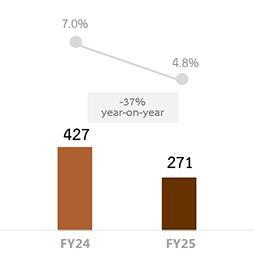
Net Profit – share of the owners Net Profit Margin (%) | 427 | 271 | (156) (2.2%) |
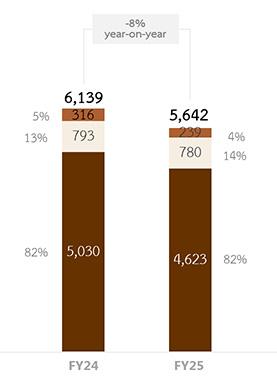
Revenue: In FY2025, total revenue amounted to 5,642 million Baht, representing an 8% decrease year-on-year. The key contributing factors were as follows:
Domestic Restaurants: Revenue decreased by 407 million Baht compared to the previous year. The decline was mainly caused by lower takeaway sales (-9%), dine-in sales (-6%), and food delivery services (-5%). This was impacted by the economic slowdown and weakened purchasing power, a decline in tourist arrivals, intense competition in the food industry, and the closure of four Maisen branches due to the expiration of their lease contracts.
Retail and OEM Business: Revenue decreased by 13 million Baht compared to the previous year, primarily due to lower sales in retail channels, particularly from mooncake products, as well as lower sales in the food service channel, specifically from the airline meals business segment.
Overseas Restaurants: Revenue decreased by 77 million Baht compared to the previous year, primarily due to the closure of one branch in the United Kingdom and lower sales in Cambodia resulting from ongoing border clashes between Thailand and Cambodia.
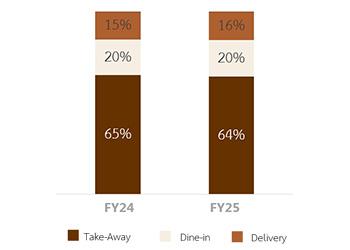
Domestic Revenue Mix (S&P stores only)
Take-away: Decreased by 9% year-on-year, primarily due to lower customer traffic at branches located in department stores and hypermarkets.
Dine-in: Decreased by 6% year-on-year, primarily due to lower customer traffic at branches in department stores and airports.
Delivery: Decreased by 5% year-on-year, primarily due to a decline in the number of large-order transactions through the 1344 call center ordering platform, while the number of orders from food aggregators (with smaller average order values) increased.
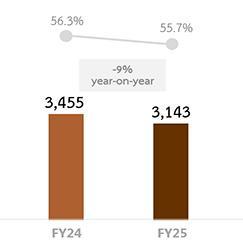
Gross Profit
% Gross Profit Margin: In FY25, this was 55.7%, a decrease of 0.6% from the previous year. The decline was primarily due to higher raw material costs. Nevertheless, the Company continued to implement LEAN production practices, reduce factory costs, and enhance procurement efficiency to maintain stable raw material costs.
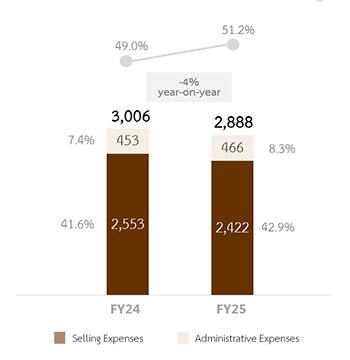
Selling and Administrative expenses
Selling and Administrative expenses: In 2025, these totaled 2,888 million Baht, a decrease of 4% year-on-year, primarily driven by lower variable expenses corresponding to the reduced revenue. However, the ratio of selling expenses and administrative expenses to total revenue was 51.2%, an increase of 2.2% from the previous year. The primary reason was lower revenue, while most expenses remained fixed, including significant costs such as higher rental expenses and increased staff costs.
Net Profit
Net profit: In FY25, this was 271 million Baht, a decrease of 37% year-on-year. The decline was mainly attributable to lower revenue and an increase in expenses with a proportion that was higher than the growth in revenue.
Debt Securities with Financial Ratio Requirements
Debt Securities with Financial Ratio Requirements Issued?
No
Factors That May Affect Financial Condition
Factors or Incidents That May Materially Affect Financial Condition
Business Outlook for 2026 Overview of the Food Industry
In 2025, the food service industry continued to face numerous challenges. Economic pressures and weakened purchasing power remained key concerns, as businesses operated amid a prolonged economic slowdown. High levels of household and corporate debt led consumers to exercise greater caution in their spending, focusing primarily on essential purchases and placing greater emphasis on value for money.
At the same time, competition intensified due to the influx of low-priced imported products, particularly from China, which has impacted Thai operators. In addition, cost volatility remained a challenge. Raw material prices continued to fluctuate due to prolonged geopolitical conflicts, natural disasters affecting agricultural output, and international trade measures such as tariffs, which may disrupt global trade costs.
Businesses also continued to face significant fixed costs, including rental and service fees for commercial spaces, particularly in high-potential locations such as shopping malls and airports, where rental rates have continued to rise. As a result of these factors, the Company’s overall sales in 2025 declined compared with 2024.
As of the end of 2025, the Company operated a total of 451 branches domestically and internationally. The Company continued to open new outlets, including new-format S&P stores, designed to better serve evolving customer segments and enhance the brand image by offering customers a refreshed in-store experience. In addition, the Company expanded its portfolio by introducing Wingstop, the world-renowned fried chicken brand from the United States, targeting the Gen Z consumer segment and diversifying the Company’s business portfolio.
The Company also continued to develop new products. The Fresh Bake business expanded its market share through innovation and the launch of new products such as Egg Tart, Shio Pan, and Pork Floss Cake, which created consumer buzz and encouraged repeat purchases. The launch of POP Cakes (0.5 pound sized) with attractive cartoon-themed designs and accessible pricing also helped attract younger consumers and value-oriented customers. Notably, Shio Pan achieved strong success, with sales exceeding 3 million pieces.
In addition, in 2025 the Company achieved significant success in revitalizing its festive product portfolio, which has long been well recognized by customers. The Company enhanced flavors, visual presentation, and packaging design to make the products more modern and appealing to new customer segments. For example, mooncakes were introduced with new flavors, a wider range of sizes, and graphic design packaging, resulting in strong sales, with some items sold out even before the festival period commenced. Similarly, improvements were made to New Year cookies in both taste and packaging design, offering a variety of visually appealing options that were well received by customers.
Strategy and Management
To prepare for growth in 2026, the Company continues to emphasize cost management and operational efficiency, including:
Raw Material Cost Management
The Company mitigates risks associated with raw material price volatility by negotiating advance purchases to lock in prices, purchasing and storing inventory during periods of lower prices, entering into medium- and long-term contracts with suppliers, and expanding the supplier base to ensure supply stability and quality.
Operational Cost Management
Lean management principles have been implemented across both factories and offices to enhance operational efficiency and profitability. The Company also reviews lease agreements and negotiates rental terms with landlords—particularly in shopping malls and airports—to ensure alignment with business performance and operational strategies.
Business Management and Growth Strategy
Expansion and Marketing Trends
Store Format and Menu Adaptation
The Company focuses on expanding branches in high-potential locations aligned with target customer segments. Store formats and menus are adjusted to suit each location, including localized menu offerings, to enhance competitive advantages.
Product Development (NPDs) and Customer Experience
The Company continues to introduce seasonal menus and health-oriented menu options that align with modern consumer trends, and new business concepts such as New Bakery Studio, which emphasizes freshly baked bread prepared in-store.
Expansion of Distribution Channels
Sales channels are being expanded through e-commerce platforms and delivery services, both through the Company’s own platforms and food aggregator platforms, as well as through expanded partnerships with large and small business partners in retail and wholesale channels.
Revenue Expansion and Sustainability
OEM Business and Strategic Partnerships
The Company plans to expand its OEM customer base, particularly with airlines and food chain networks, while focusing on the joint development of new products (NPDs), with both large and small partners.
Digital and Delivery Channels
The Company aims to increase the proportion of sales generated through delivery platforms, including both its own channels and food aggregators, enabling customers to access products more conveniently across various consumption occasions.
ESG and Sustainable Brand Value
Future business direction will continue to be driven by the concept of “IGNITE GROWTH, ELEVATE BRAND VALUE.” The Company emphasizes sustainable growth through the following priorities:
Environmental Initiatives (Green Store Concept)
Store design and decoration will incorporate environmentally friendly practices, including energy-efficient operations and the use of sustainable materials while maintaining a modern store experience.
ESG-Oriented Operations
The Company remains committed to sustainable value chain management from upstream to downstream operations, guided by the core principles of “Quality, Value, and Virtue.” These principles help maintain operational standards and build credibility, contributing to recognition such as the Company’s SET ESG Rating at the AA level.
Through these initiatives, the Company aims to strengthen its competitiveness, enhance brand value, and achieve sustainable long-term growth.